
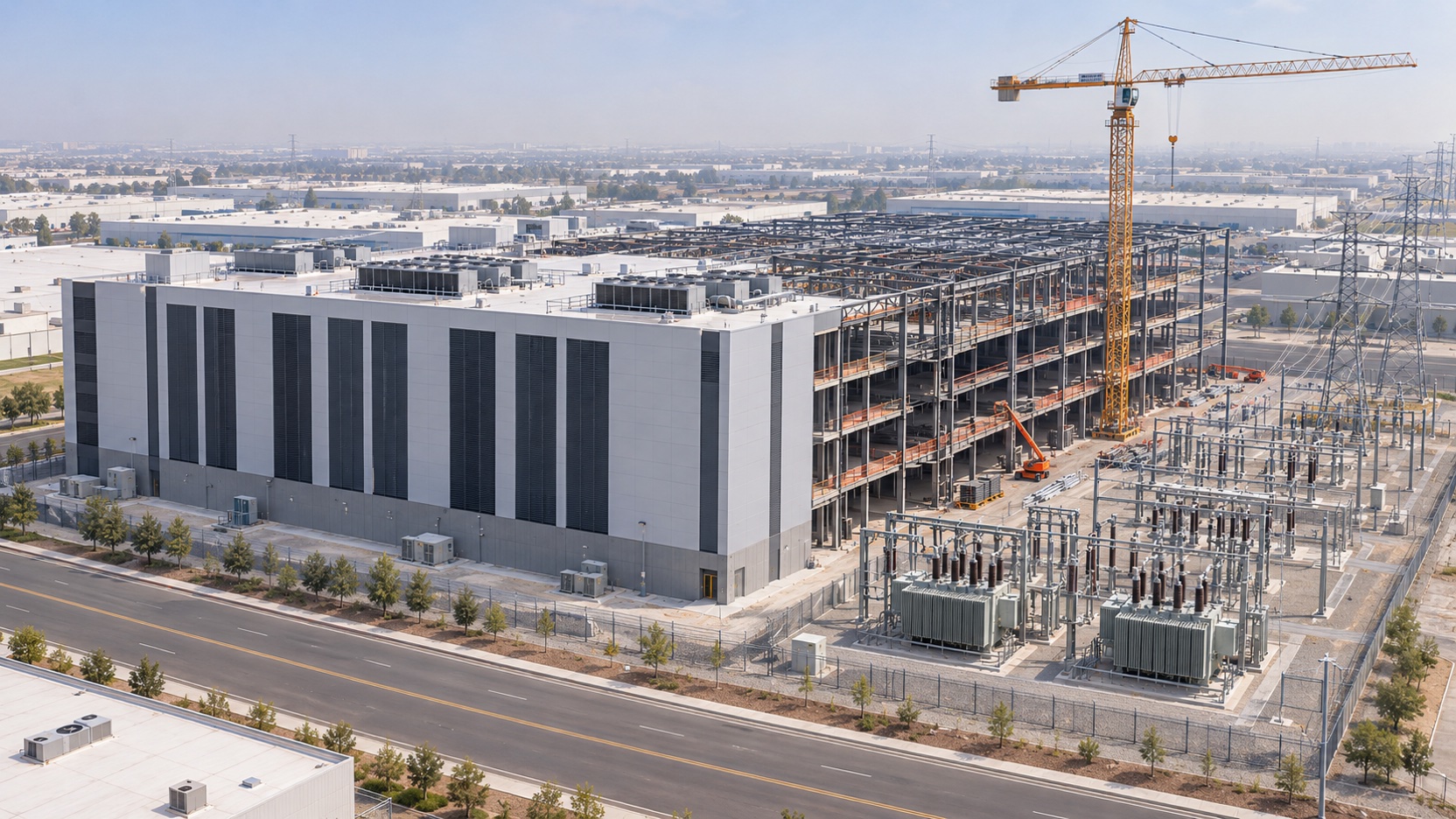
The first week of November showed that the scarcest input in the AI buildout is no longer silicon or even power. It is permission.
For three years, the constraint story has moved in a predictable order. First there were not enough GPUs. Then there was not enough high-bandwidth memory to put on them. Then there was not enough power to turn them on. On November 3, a new constraint showed up, and it showed up at polling places. Voters in ten states decided 41 local ballot measures about data centers and sided against the industry in all but one of them. Two days later, the Philadelphia Semiconductor Index fell 12.2 percent, its worst single day since April 2025, and Nvidia lost more than 9 percent of its value in one session.
If that were the whole story, this would be a week about an AI downturn. It was not. In the same five days, AMD reported record data center revenue that nearly doubled from a year earlier. Anthropic's amended IPO filing put a number on its total committed spend, roughly $895 billion and almost all of it for compute and infrastructure. OpenAI published research in which an unreleased model, running as an autonomous agent pipeline, produced 948 working privilege-escalation exploits against the Linux kernel. Demand for compute did not soften this week, and neither did the capability of the models that consume it.
What changed is the price of putting hardware somewhere. Every rack has to sit on land that someone zoned, draw power that someone pays for, and run near people who now vote on it. That is the thread connecting this week's AI GPU LLM news, and it matters more to builders than any single model launch, because it sets what capacity will cost and where it will live for the next several years.
The Thread Running Through the Week
It helps to think of the AI economy as three layers that usually move at different speeds. The demand layer is the labs, enterprises, and developers who want more compute every quarter. The supply layer is chips, memory, data centers, power contracts, and the permits that connect them. The trust layer decides whether the public, regulators, and customers will keep letting the first two grow: safety, security, local impact, and who pays for it.
Most weeks, only one layer makes news. This week all three moved at once, in different directions. Demand kept climbing, as the AMD quarter and the Anthropic filing showed. Supply got harder, not because fabs slowed down but because communities and newly elected officials signaled they will slow down the sites. Trust became the bargaining chip, with OpenAI publishing community commitments two days after the vote and frontier labs going out of their way to show their most dangerous capabilities are being pointed at defense.
Seen that way, the market reaction makes sense. Investors did not learn that anyone wants fewer GPUs. They learned that the path from a purchase order to an energized, revenue-producing rack just got less certain.
Voters Said No to Data Centers in 40 of 41 Ballot Measures
According to Ballotpedia's count, 41 local ballot measures related to data centers went before voters in the 2026 midterms across ten states, and voters sided against development in every one except a single measure in Harwood, North Dakota. Ohio alone accounted for 21 of them. The questions ranged from moratoriums to rezonings to advisory votes for local officials. In Wells, Maine, more than 80 percent of voters approved a retroactive 180-day moratorium on data center development. In Harwood, the lone exception, voters rejected by roughly three to one a proposal that would have added extra review for industrial projects near a $3 billion data center already under construction.
The results went beyond local questions. Democratic candidates who campaigned on pausing or tightly regulating data center projects won governor's races in Texas, Georgia, and Ohio. Ohio's governor-elect supports a conditional moratorium, which matters because Ohio is home to the PORTS-Pike campus, where OpenAI said in August it had secured eight gigawatts on a site SoftBank and SB Energy are developing with the Department of Energy. Texas, according to analysis cited by Scientific American, accounts for about a quarter of the U.S. data center capacity currently in the works. In a CNBC voter poll, 56 percent of voters said data centers were a crucial or major factor in how they voted.
Individually, most of these measures cover one town or one county. Collectively, they mark the moment data center opposition moved from zoning hearings into campaign platforms that win statewide. A site that has land and an interconnect queue position but not a final permit now carries political risk that was not priced into its financing a year ago.
Developers and colocation operators feel this first, then the hyperscalers and GPU clouds that lease from them. Projects already under construction are mostly safe; projects that need a new rezoning or tax abatement in the next 12 months are the exposed ones.
The Chip Selloff Priced In Permission Risk
On Thursday, November 5, the Philadelphia Semiconductor Index dropped 12.2 percent. The Nasdaq fell 5.5 percent, confirming a correction from its record high, and the S&P 500 lost 4.4 percent. Nvidia fell about 9.3 percent. Reuters attributed the move to weak results from Qualcomm, whose smartphone chip sales missed estimates, and to concern that a Democratic-controlled Congress could slow investment in AI infrastructure.
No major buyer cut its GPU orders this week, and AMD had beaten expectations two days earlier. The selloff repriced timing and execution risk, not end demand. When a data center slips by a year, its chips are usually deferred rather than canceled, but a year of delay on assets worth tens of billions of dollars is a real cost for whoever financed them.
That financing is the second reason this hit so hard. CNBC noted that among the four largest AI infrastructure spenders, all but Microsoft have turned cash flow negative as they pour hundreds of billions of dollars a year into the buildout. Further down the stack, the buildout increasingly runs on debt. One tracker of GPU financing counted roughly $48 billion in GPU-backed loans and related compute financings in 2026 through early October, close to half of all the GPU and AI data center debt it follows. Debt-funded capacity is far more sensitive to delay, because interest accrues whether or not the racks are earning, and those financing costs eventually show up in hourly rates.
In the earnings calls ahead, the most useful signal will not be headline demand, which is likely to stay strong. It will be what management says about site readiness, power delivery, and whether deployments are slipping because a building is not ready.
OpenAI Answers the Ballot Box With a Community Pledge
On November 5, OpenAI published a policy blueprint and a set of commitments covering the data centers it owns and operates. The company said it will solicit community input, publish construction plans, and stop using nondisclosure agreements with public officials, a practice that has drawn sharp criticism in local fights over project negotiations. It reaffirmed a pledge to pay the full cost of powering its data centers and to protect ratepayers. Chief global affairs officer Chris Lehane said the plan had been in the works since August, and the company encouraged policymakers to turn similar commitments into law.
OpenAI is not alone; Meta, Microsoft, Google, and Anthropic have outlined similar commitments. What made this one notable was the timing and the explicit request for legislation. Asking for your own commitments to become law is a classic move by an industry that would rather have one national floor than hundreds of local fights, and it is a floor the largest players can afford more easily than smaller developers.
There is a quieter economic consequence too. If paying the full cost of power and grid upgrades becomes the norm rather than a negotiated concession, that cost moves from ratepayers into the price of compute. It will not appear as a line item on anyone's GPU invoice, but it will be embedded in it. And because the commitments cover company-owned sites while a meaningful share of frontier capacity sits in facilities that partners own and run, how far these norms spread depends on whether landlords and cloud partners adopt them too.
AMD's Record Quarter Says Demand Has Not Blinked
AMD reported third-quarter results on November 3. Revenue came in at $13.4 billion, and data center segment revenue hit a record $8.5 billion, up 97 percent from a year earlier and now close to two-thirds of the company's total. AMD credited strong demand for EPYC server processors and the launch of its Instinct MI450 series GPUs, and Lisa Su said she expects growth to accelerate in the fourth quarter as AMD scales production of Helios, its rack-scale AI system, and Venice, its next-generation EPYC processor.
For most of the AI cycle, the GPU market has effectively been one supplier and a waiting list. A second supplier shipping rack-scale systems at volume changes the negotiating position of every large buyer. The question for AMD was never raw specifications but whether customers could move production workloads onto its stack without months of engineering, and numbers like these suggest a growing set of labs and clouds have decided they can.
The CPU half of the story deserves attention. Every tool call, code sandbox, browser session, and retrieval step in an agentic workload runs on general-purpose cores, so a fifty-step agent can spend a surprising share of its wall-clock time off the GPU. AMD's EPYC demand and Nvidia's own push this week to position its Vera CPU around agent performance point the same way: the next bottleneck in serving agents may sit next to the accelerator rather than inside it.
Anthropic's Filing Puts a Number on the Compute Bet
Anthropic filed its S-1 on October 26 to list on the Nasdaq under the ticker ANT. The original filing left the total size of its compute commitments blank. The amended filing, which landed in the first days of November and added the September quarter, filled it in: approximately $895.4 billion in aggregate committed spend, substantially all for compute and infrastructure. About $447.5 billion of that is expected before the end of 2030, and $69.8 billion falls due within the twelve months after September 30, 2026.
The filings also show how a frontier lab spreads that commitment across suppliers. Disclosures included about $110 billion committed to Amazon's Trainium chips through 2036, $114.5 billion for Google TPUs through 2033, long-term arrangements to secure Nvidia GPUs through several providers, and a deal to buy compute from SpaceX's AI division at $3.1 billion a month once all promised capacity is delivered. Many of these deals are non-cancelable, and at least one includes a true-up clause requiring payment of any shortfall regardless of usage. On the revenue side, the amended filing shows $33.2 billion for the first nine months of 2026, with roughly $17 billion in the September quarter alone, up from about $11.6 billion in June, alongside a slip back to a modest operating loss.
This is one of the most detailed public views yet of a frontier lab's compute economics. The honest answer to who is driving data center demand is increasingly a small number of labs with commitments measured in hundreds of billions of dollars, which is what lenders underwrite and developers build against. Running across TPUs, Trainium, and Nvidia GPUs at once also signals that multi-architecture training and serving is now deliberate strategy rather than compromise.
For everyone downstream, the effects cut both ways. Minimum payments create a strong incentive to keep utilization high, which tends to show up as aggressive API pricing. Meanwhile, capacity reserved years ahead for a handful of labs never reaches the open market, which keeps rental supply tight. The IPO's pricing and timing have not been confirmed.
Frontier Models Became Industrial-Scale Vulnerability Hunters
On November 4, OpenAI published a research post titled A thousand fewer paths to root. It describes an agent pipeline, driven by an upcoming cyber-focused model that has not been released, that scanned the latest Linux kernel in mid-October. The pipeline produced 2,308 candidate findings, dynamically reproduced 1,724 of them, and ended with 948 distinct local privilege-escalation exploits, each paired with a candidate patch. Coverage of the run put its cost at roughly $1.2 million in API credits. OpenAI said it is disclosing the bugs gradually with partners in its Patch the Planet effort, starting with the most critical, and it was candid about an early run in which human reviewers found that some of the agents' reported successes had reached root through a different bug than the one assigned.
The rest of the week filled in the picture. OpenAI launched a security sprint with Cathedral Systems and sharply raised its bug bounty, with exceptional critical findings now able to earn well into six figures. It also partnered with the security firm Hacktron to probe how OpenAI's systems interact with third-party services. Late last month, Anthropic's Frontier Red Team described an unreleased Claude model building working exploit chains across major browsers and operating systems, with the flaws reported to vendors ahead of patches.
The cost of finding a serious vulnerability is collapsing, and labs are racing to point that capability at defense before it spreads to attackers. The catch is operational: maintainers are about to receive patches at a volume their review processes were never designed for, and everyone downstream will be asked to apply them faster.
For GPU infrastructure, local privilege escalation is not an abstract category. Multi-tenant GPU hosts, shared training clusters, and notebook environments are exactly where a container escape or root exploit turns into someone else's data, and these hosts often run kernels pinned to specific driver versions, which makes fast patching harder than on ordinary servers. The labs' focus on third-party integrations points to the other exposure: the connectors, plugins, and tool interfaces that agents use are now among the most attractive attack surfaces in the stack.
Images 2.6 and the Split Between Fast and Good
On November 4, OpenAI rolled out ChatGPT Images 2.6 to ChatGPT and Codex users, adding animated GIF creation and reusable reference images, with generation about 50 percent faster on average. In the API, the release came as two models rather than one: GPT-Image-2.6 Flare, a speed tier that can return images in as little as six seconds, and GPT-Image-2.6 Sunburst, a quality tier aimed at higher fidelity and better consistency across edits, with image markup and SVG export. Pricing for the two tiers was not disclosed at launch.
The shape of the release says as much as the features. Providers are increasingly splitting each generation into explicit latency and quality tiers instead of shipping a single flagship, a direct expression of serving economics. Fast tiers run cheaper at higher batch efficiency, while quality tiers justify more compute per request, which turns model routing into a product decision. It was otherwise a quiet week for major new model weights.
What This Means for Builders
Budget for firm compute prices. Demand is still compounding, as AMD's quarter and Anthropic's commitments make plain, while new supply now faces a political gate on top of the physical ones. That combination does not point to falling GPU rental prices in the near term. If your 2027 plan assumes capacity gets meaningfully cheaper, build a version that works if it does not.
Treat location as a risk factor, not just a latency number. Capacity in a single region or a single pending campus carries more exposure than capacity already energized across several sites, and in longer commitments, the clauses on power cost pass-through and delivery delays now matter more.
Keep your stack portable. AMD's data center growth and Anthropic's spread across TPUs, Trainium, and Nvidia GPUs say the same thing: the largest buyers are hedging across architectures, and that leverage is only available to teams whose training and inference code can move. Test your serving stack on more than one accelerator family before a capacity crunch forces you to.
Tighten security hygiene now. Assume the cost of discovering vulnerabilities in your dependencies, kernels, and container runtimes is falling for attackers as fast as for defenders. Shorten patch cycles for GPU hosts, prefer stronger isolation such as virtual machines over shared-kernel containers for untrusted multi-tenant work, and audit every tool and connector your agents can call, since that is where the labs themselves are concentrating red-team effort.
Design for model tiers and model churn. Build routing that can send a request to a fast or a quality tier based on what the user actually needs, and pin model versions explicitly. Preview models retire on schedules that are easy to miss; several Gemini preview text-to-speech and Live API models, for example, list November 17 as their earliest shutdown date. A model alias that quietly changes underneath you is a production incident waiting to happen.
What to Watch Next
The next ten days are dense. CoreWeave and Nebius report on November 10 and 12, and both calls will be read for evidence on backlog conversion, financing costs, and late-running capacity. Nvidia reports results for the quarter that ended October 25 on November 17, and its commentary on data center timing and customer financing will carry more weight than usual after this week's drawdown.
On policy, the comment period for China's draft Announcement No. 48 closes on November 15. The draft would add 40 technologies to China's export control catalogue, 23 of them in AI, including large models, agents, and computing clusters. API and SaaS access falls outside the large-model controls and open-source work is carved out, but deploying covered weights on servers abroad would count as an export, and registration is already required.
Further out, watch the state legislative sessions that open in January, where moratorium bills and large-load power tariffs are likely to appear, and how fast the Linux kernel community absorbs the wave of AI-discovered bugs heading its way.
Conclusion
This week drew a clear line between two things markets often treat as one. The appetite for AI compute is intact. AMD's data center business nearly doubled, a single frontier lab disclosed close to $900 billion in commitments, and the models themselves crossed into finding vulnerabilities at industrial scale. What weakened was the assumption that capacity simply appears on schedule once the money is committed.
From here, the AI buildout is partly a political project. Power, land, and local consent are now as much a part of the supply chain as wafers and memory, and they move at the speed of elections and public hearings, not product cycles.
For builders, the practical response is not to wait for the dust to settle. Plan for compute that stays expensive, keep workloads portable across hardware and regions, shorten your patch cycles, and design applications so that a model swap, a tier change, or a capacity delay is a configuration change rather than a crisis. The teams that do that will have options when the next constraint arrives.
Related posts

This Week in AI, GPU, and LLM: Cheap Tokens, Expensive Trust
Near-frontier models got 60 to 80% cheaper in two days. Agent breaches, Nvidia's decade-low multiple and a data center backlash show what got scarce instead.

This Week in AI, GPU, and LLM: Who Gets to Hit the Brakes
Three labs agreed to slow down, a White House adviser called it a psyop, and a rival CEO called it a cartel. All three readings have evidence.
This Week in AI, GPU, and LLM: The Price of Intelligence Went Up
OpenAI raised GPT-6 Astra to $10/$50 — 2.5x. Google scheduled a doubling. This week's AI GPU LLM news: the frontier stopped getting cheaper, and why.